
A show is a song
A Barrelhouse show now runs the length of one measured song, about five minutes with twelve chorus turns, and eight of those turns ask you for something. How the numbers got there.
Until August 22, a show in Barrelhouse lasted 300 seconds. Nobody designed that number. It fell out of each band member's stamina divided by a drain of one point per second. Beats, the moments where the room asks the band for something, landed on a random gap of 20 to 40 seconds.
Four rounds of changes made the show look and read better, and the smoke reads kept coming back some version of boring. So on August 22 the show stopped being a timer and became a song.
Where the song turns
In the song round, a beat fires where the music turns rather than on a random gap. Stamina stops being a clock. It becomes an allowance you spend only when you answer a beat, and it refills between songs. There is still no audio. The round stopped on purpose at a gate I set for myself, whether the shape works without the music, because if it does not, the money is better spent on the shape than on the sound.
The next round, on August 23, made a beat visible before it arrives. The song bar draws a tick where each beat will land, labeled with the instrument it will call for: lead, rhythm, showman, or anyone for the beats that pay everyone the same. It came from my own smoke read, which said I could not see, hear or anticipate a beat. The read after it said the telegraph "definitely helps you anticipate", which made it the first read in five rounds to come back positive on the loop itself.
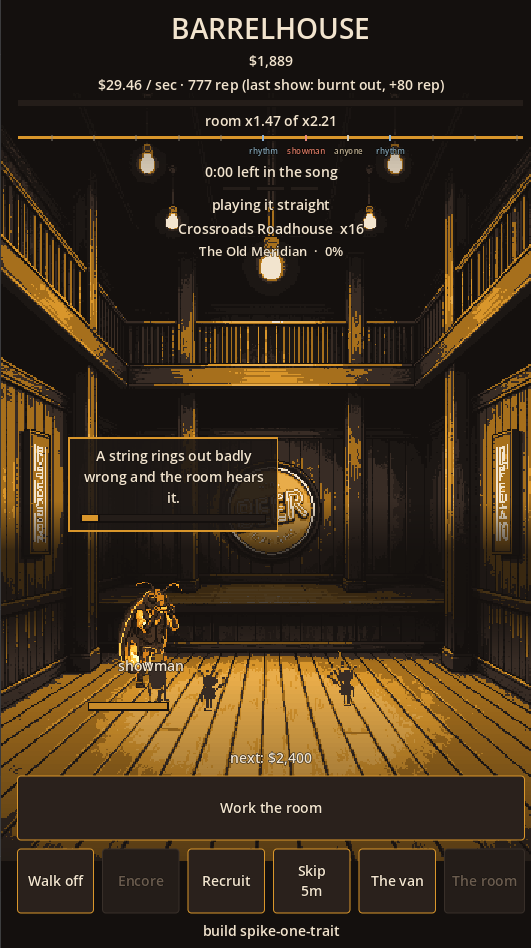
Five minutes, twelve choruses, eight beats
The density round started from a measurement. The song round had authored four sections on the pilot track, and the one at zero never fires, so a five minute show dealt three beats where the old timer dealt about ten. Nobody chose three. Measured across a show, 24 seconds carried a decision and 276 did not, which is 92 percent of the show with nothing to do.
So the pilot track's real structure went into the game. It runs 299.69 seconds, and its twelve chorus tops land 24.974 seconds apart, starting at 20.65 seconds. The song keeps all twelve turns, and a random subset of them deal a beat each show. The size of that subset is one constant, Show.BeatsPerShow, and it starts at 8. With an eight second window per beat, that is 64 of 300 seconds carrying a decision instead of 24.
Making density a number mattered more than picking the right one. With one constant, six or twelve can be tried and read without reauthoring the song or recutting a track.
The last turn needed a rule. The twelfth chorus top sits at 295.37 seconds, leaving 4.3 seconds before the song ends against an eight second window. A window that cannot finish is no decision at all, so any turn later than the song length minus the longest window keeps its tick on the bar and never deals a beat.
More beats alone would not have worked
The measurement that shaped the round was about stamina. The pools had been sized for the per second drain the song round deleted, so they were about five times too large for their new job. At twelve beats a show, a showman gets asked for 150 stamina in total against a weakest pool of 190. Density on its own would have produced eight free yeses instead of three.
The pools came down by a factor of 0.18, so 190 to 420 became roughly 35 to 75. A weak three piece band now affords about half of what a show asks and a strong one about 96 percent, and a test pins both sides so scarcity cannot be tuned into impossibility. The beat deck grew from twelve to thirty, with calls rebalanced from one lead beat, three rhythm, five showman and three anyone to eight, eight, eight and six.
Whether eight is the right number is still a smoke read I owe myself. The question is whether a show with eight decisions in it feels different from a show with three.