
Cutting it down to size
In April the card game grew into an open world RPG. This week it went back to being a roguelike deckbuilder, with two acts, no relics, a test suite, and a mouse bug that had sat in the combat screen since April.
On April 13, the same day the journal first called a battle playable from start to finish, the game changed shape. That session's journal records a "scope misalignment" and redefines the project as a large open world RPG. A full game design document went in. It covered biomes, classes and jobs, skill trees, fame and karma, crafting, NPC relationships and an economy. The roguelike run state was deleted in favor of a persistent player character and a save manager. A world scene shipped with eight-directional movement and random encounters. The recorded reasoning was that exploration and discovery were the main appeal.
The card work kept going inside that shell. On April 15 the Blues school got its first real set, twelve cards named for harmonica techniques (Tongue Slap, Bend, Overblow, Call, Response, Final Verse and others), built around a new stacking resource called Resonance. Resonance first decayed every round, and testing showed the decay zeroed it before the player could spend it, so the decay came out the same day. By April 18 the world had twelve shops and six towns.
The last commit of that stretch is dated April 18. After it the repo went quiet, with no commits until July 29.
Coming back to it
The first thing written on July 29 was a design spec that checked the repo as it stood and named that April commit as the last one. It kept the combat system, the cards, and the Resonance, Linger and Stance mechanics, and made them the whole game. The world layer was cut from v1 and deferred to a later open-world project that would reuse the same card system.
The spec's reason is a count. The design document carried fifteen systems that had never been designed, from skill trees and crafting to dungeon generation and a story structure. The spec calls that a multi-year solo project and says it does not ship. The combat system, by contrast, was built and distinctive.
The target moved too. April had put Steam on PC first. The July spec aims at Android, sold through one purchase, on the grounds that roguelike deckbuilders have proven premium sales on mobile and that pay-once models are what Godot's mobile tooling supports well.
Five minutes after that spec was committed, the scope came down again. Three acts became two, and Charms, the relics, moved out of v1 to the first update after launch. The spec states the cost plainly. With no relic layer, card variety and enemy design carry all of the replayability.
The starting inventory was 30 cards, 2 enemies and no tests, and every enemy shared one hardcoded four-step attack pattern. The first merged work of the return moved enemy movesets into authored data, alongside a new test project.
The bug in the hand
July 30 brought the run structure (a seeded act map, battles, rewards and a run save), merged with 77 tests. Status effects followed the same day at 130.
Two defects got past those tests. The map was taller than the screen, so the boss was drawn off it and no run could be finished, while 69 tests passed. That one was caught by reading, late.
The second was caught by playing a full run. Cards did not respond to the mouse. The card scene set its own mouse filter to Stop so it could handle clicks, but three containers inside it set nothing and took Godot's default, which is also Stop. They covered the card and swallowed every click. Setting those three to Ignore fixed it. The commit that introduced the problem dates from April 13, so the combat screen had been buildable and reviewable, but not playable with a mouse, for about three and a half months. No test opened a scene, so nothing noticed.
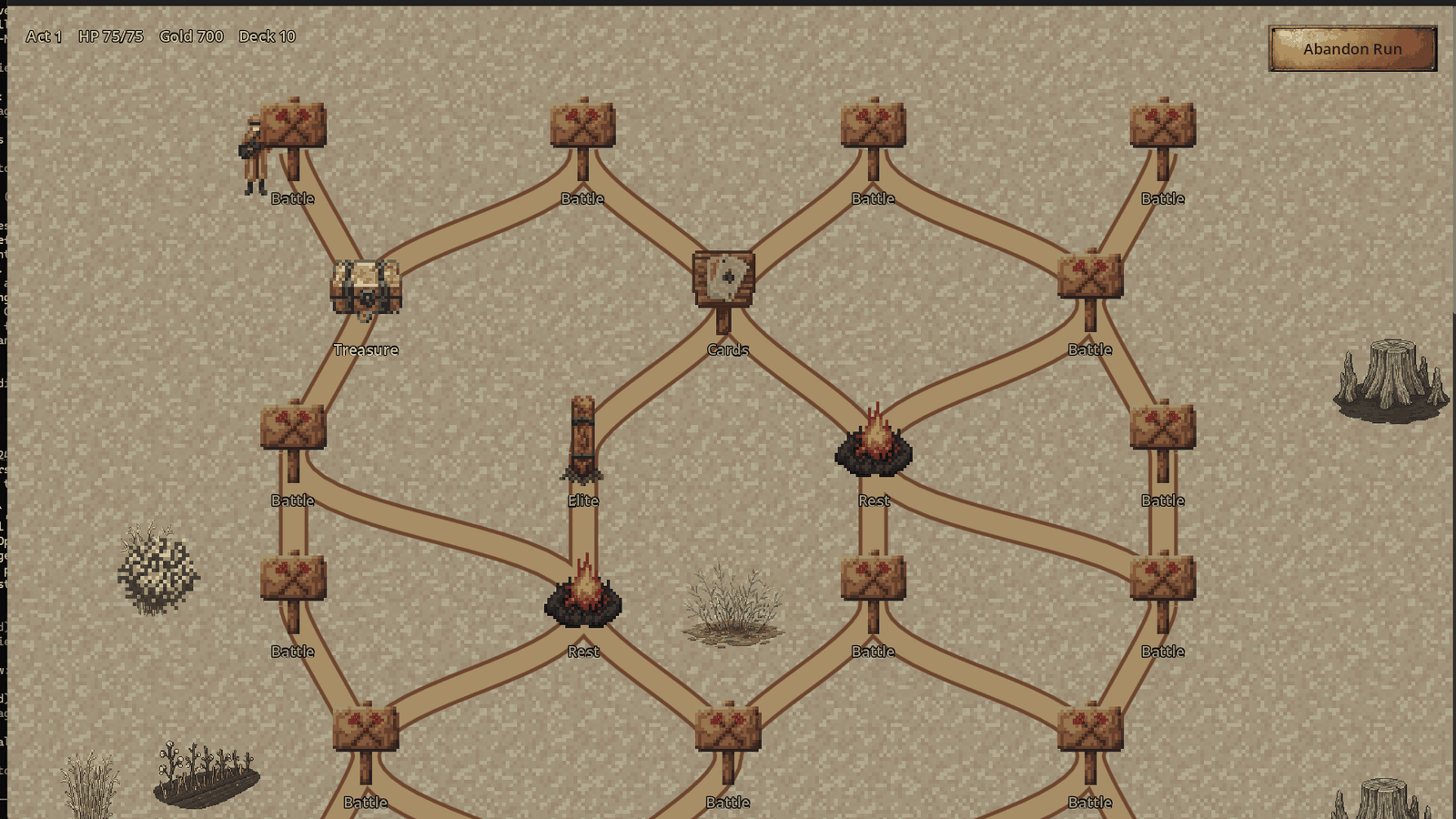
That map comes from a later build with art, and its shape is the one merged this week, a branching path of fights, rests and rewards with a deck that grows along the way.
A roadmap and a project instruction file went into the repo today for the first time. The first entry in the roadmap's findings says a full run was played this afternoon and works end to end.