
Making it look designed
Art direction was cut in July and brought back in August, because a game that will not pay for installs is sold by its screenshots. Two art styles in five days, a pixel pivot decided by looking at it running, and the first music.
When the game was cut down to size in July, art direction went with it. On August 12 it came back. The reasoning is narrow. A premium price rules out paying for installs, so the store listing does all the selling, and the listing is screenshots of the game.
The spec that brought it back started by counting. The repo held three tracked images and the game used one. It had no custom fonts and no theme resources. The 47 cards fell into only eight combinations of school and card type, so eight shared illustrations could cover every card, and a new card would inherit art without anyone drawing it.
The first phase had no generated art in it at all. It was a card frame, a theme and flat school colors, built so that if generation stalled or the output was rejected, the game would still look designed. Every card also carries a school icon. Funk's orange and Folk's earth brown are the one pair in the palette that converge for the most common forms of color blindness, so shape carries the school as well as color.
Two styles in five days
On August 13 the direction was ink and wash. Six painted candidates had come back good, and the style lock that day cut pixel art outright and wrote down why. Pixel deckbuilders are a crowded field, and image generators do not produce true pixel art, only a painterly image under a pixel filter. By August 16 all twenty enemies had painted figures, after four rounds of prompts.
On August 17 I tried RetroDiffusion, a generator built for pixel art, on four trial images. They converted cleanly, and they raised a problem. A pixel figure composited on a painted background reads as two media stapled together, so there was no gradual path. The first enemy to convert would drag its background with it, then the cards and the chrome.
So the question went to a vertical slice. One enemy, its background and two card arts, all pixel, running in the real battle scene, to answer whether it still read as Blues Wanderer. My verdict on seeing it run was that it felt like "the game I initially pictured." That was the decision.
All twenty enemies converted the same day. The painted figures did not go to waste. Each one was the reference image for its pixel version, and without it the same enemy lost its head, lost its character and drifted into orange. No prompt enforced the palette. The references held it across all twenty. The scale settled at 4x. The first pick, 5x, was chosen because the arithmetic landed neatly, and it came back with eight torso crops. Twenty figures take 185 KB, against about 15 MB of watercolor.
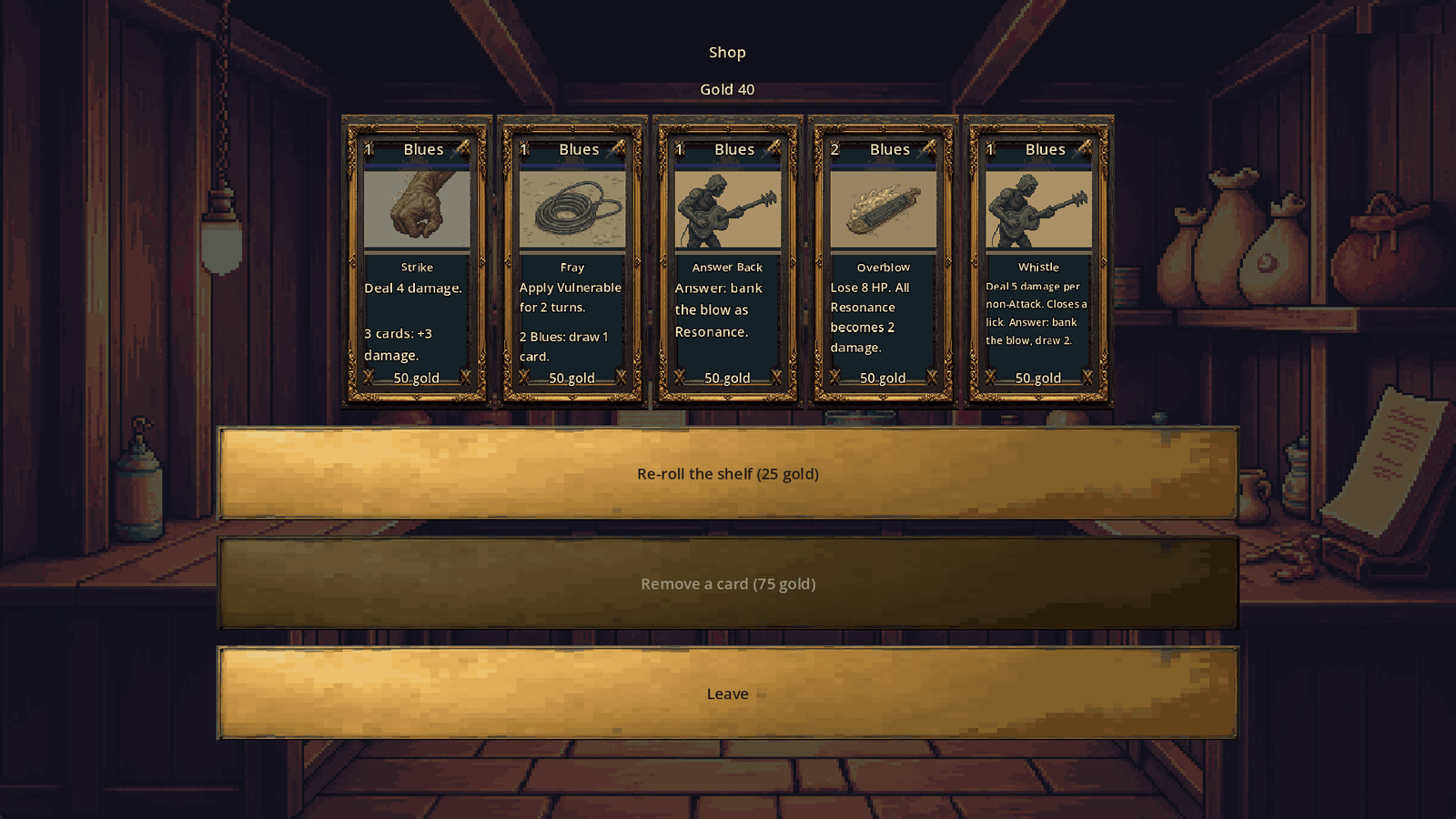
On August 18, 37 cards got art of their own, and card faces started rendering from card data alone. Every event got a picture of the scene you walk into, and the map screen got fourteen images the next day.
A UI scaling pass on August 22 broke the enemy figures' pixel grid, because the relationship between art size and render size had never been written down. The asset guide came out of that, measured from the files rather than copied from the specs.
A sound
Today the game made its first sound. Five looping cues ship behind a new audio director that crossfades between them and is reachable from every screen. A layered design driven by Resonance is deferred on purpose.
The trims were measured rather than judged by ear. Both battle tracks are cut at a false ending, where each resolves before an encore section, so the loop lands on a real cadence. The first finding from playing with it is that one track per context sounds thin. It is not acted on yet, because one sitting is not a run.
Underneath the new face, one gap is left in the rules. Three of the 25 effect handlers still have a body that only logs an error. They are the verbs Rock, Jazz and Hip Hop were designed around, and no card uses them yet.