
Where The Lien stands
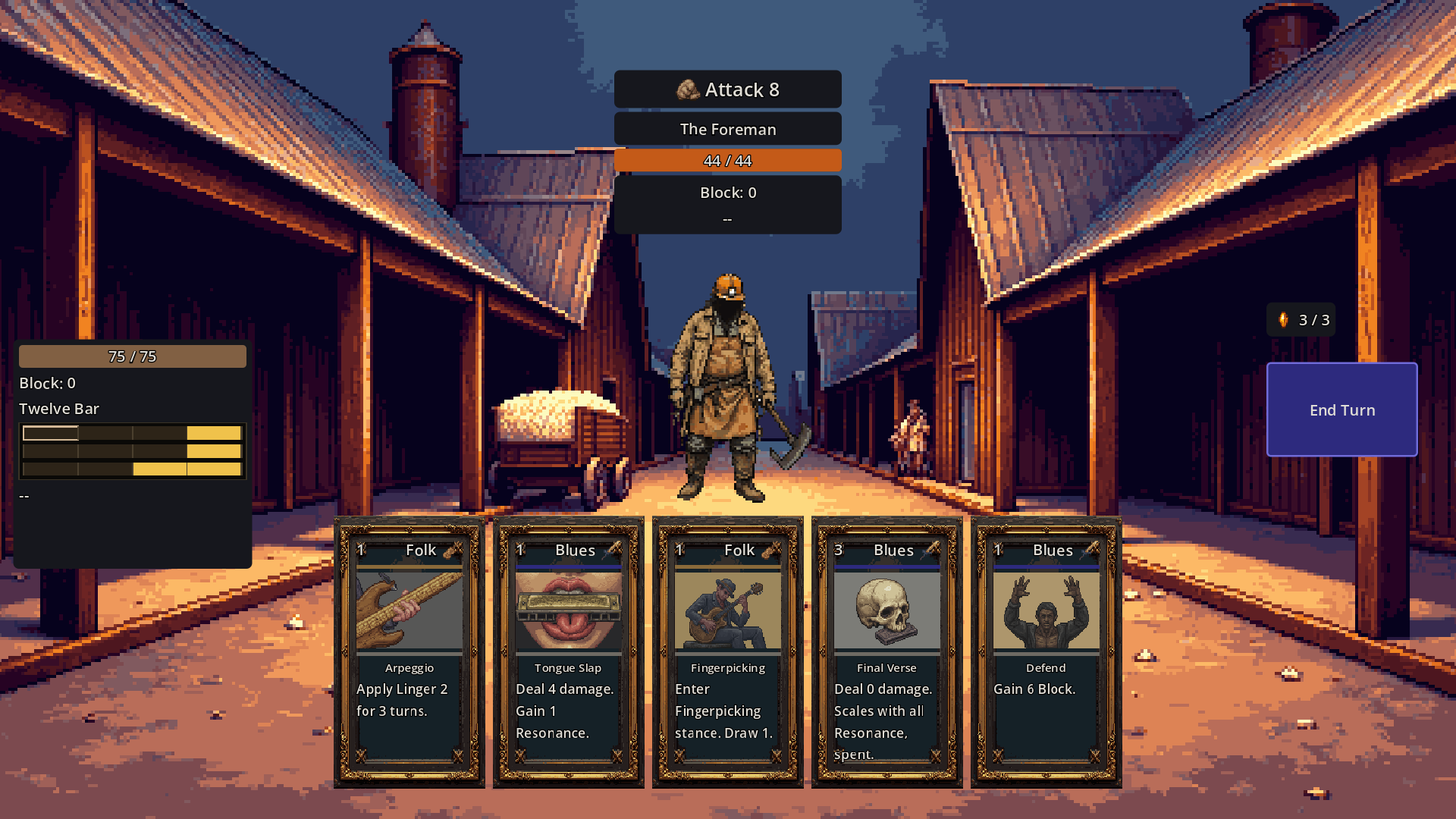
The Lien is a roguelike deckbuilder where music is the magic system. How the schools, Resonance, Linger and Stance work, what landed lately, and how PC builds reach testers.
The Lien is a run-based roguelike deckbuilder for PC, set on the road north out of the Mississippi Delta. It is built in Godot 4.6 with C#, and it is planned as a game you buy once and play offline.
The name
The working title, Blues Wanderer, was always a placeholder, and it was retired on September 16. The game then spent ten days as Bottomland: The Lien, and on September 26 it became plain The Lien. The code, the assembly and the namespace are still named Bottomland.
Music is the magic
Every card belongs to a school of music, and each school has its own mechanical identity. In the design document Blues is the foundation school (sustained damage, healing and drain), Folk is persistence (effects that linger across rounds), and Funk is disruption (forcing changes in how enemies behave).
Three mechanics carry most of that identity.
Resonance is what a fight banks up and one card spends. It sits there doing nothing until something cashes it in, and then it goes all at once. Every battle starts at none.
Linger is a pile of stacks that sit on the enemy. On its own it does nothing. The Folk cards that read it turn those stacks into damage, or into healing for you. Since September 26 it fades. A round that ends with no Linger card played takes half of it away.
Stance is a way of playing that stays on you instead of firing once. Only one holds at a time.
PC first
The game was planned for Android until September 16, when it pivoted to PC. The roadmap records that distribution, market and audience decided it. The switch was cheap. The project had always been authored at a desktop aspect ratio, and no in-app purchase had ever been built.
PC is the rail v1 ships on. Since September 17 a GitHub Actions workflow exports a Windows build and pushes it to an itch.io channel that testers reach with a download key. That route was chosen for patching, and the claim was measured. The second build moved a 482 KiB patch against 91.91 MiB for the first upload. The Android build is kept and unshipped. Steam still needs an App ID, money and a review before it replaces anything.
What changed recently
The repo has taken 1,508 commits since June. The run structure, status effects and enemy behavior as data landed at the end of July. Written events, each with its own picture, arrived in August, along with the map screen and a light first pass at music. Six sound effects shipped on September 5, recorded from household objects.
The last week went mostly to the juke joint. Act 1's card node became a walkable room with regulars and tables. The first quest, Joseph Isaac's errand to Mounds Landing, shipped on September 24 with a narrated walk. Twenty-one, tonk and Georgia skin each got a table on September 25, and every table got a Rules page. On September 26 hold'em became something you buy in the Hoodoo shop, and work began on Lien, the wanderer's own card game, with its rules and a rules engine.
What is next
The Winterville quest is next in line. Animation and game feel have a first slice and a lot left. Voice narration is deliberately one of the last phases, one narrator for the whole game.
There is also the smoke ledger, the list of claims that only a person at the running game can settle. Tests do not clear it.